
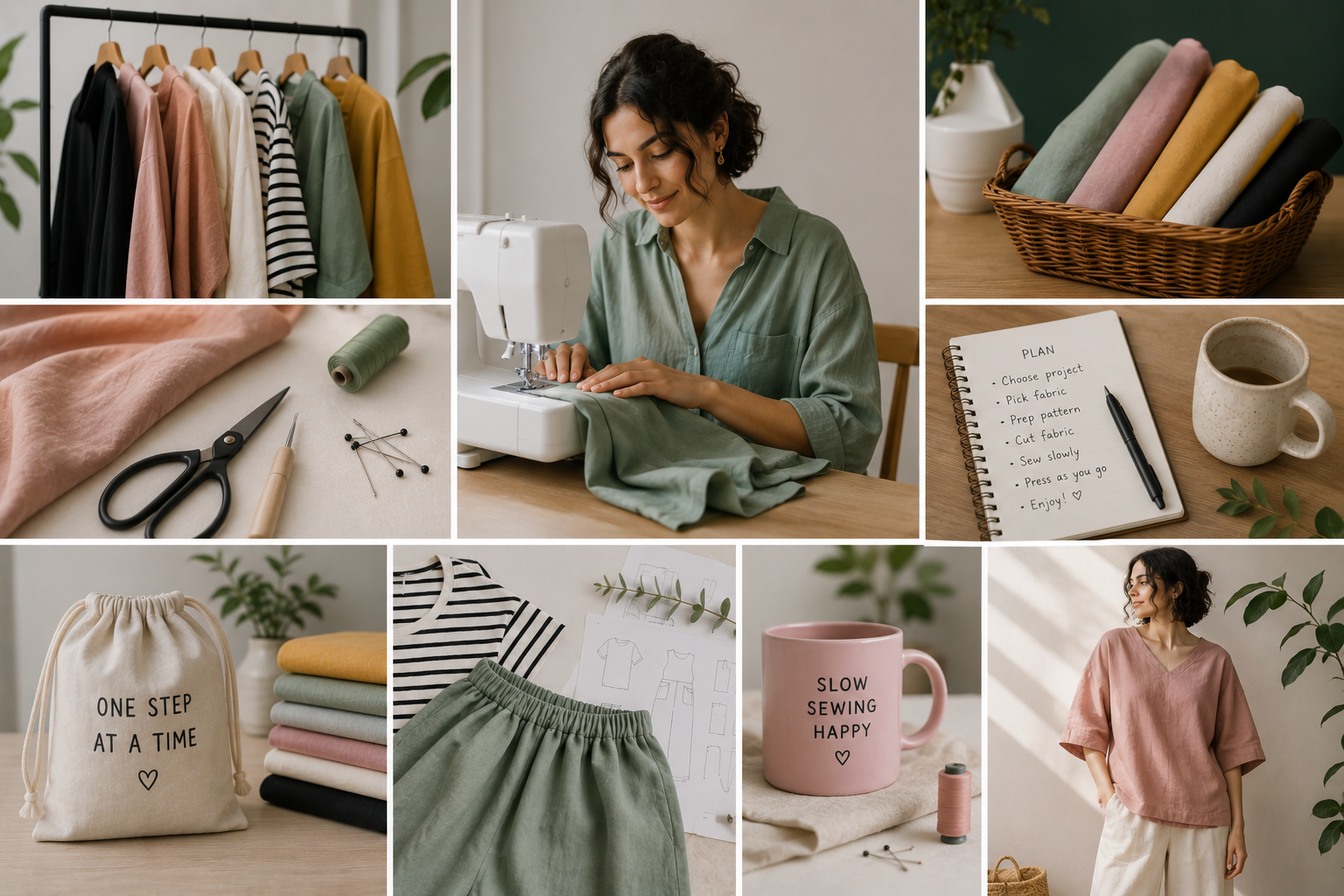
The first time you sit at a sewing machine, even threading it can feel like a test. The good news is that learning how to sew for beginners does not have to start with fitted dresses, invisible zippers, or confusing pattern symbols. It can start with one straight seam, one simple project, and the relief of realizing, oh, I can actually do this.
If you are brand new, the fastest way to enjoy sewing is to make it smaller, simpler, and more forgiving than you think it needs to be. Sewing gets overwhelming when beginners try to learn everything at once. You do not need to master every tool, fabric, and technique before you begin. You need a clear starting point, a project that gives you room to learn, and enough patience to let your first results be imperfect.
How to sew for beginners: start with the right setup
A basic setup is enough. You need a sewing machine that can do a straight stitch and a zigzag stitch, fabric scissors, pins or clips, a measuring tape, an iron, and a seam ripper. That last one matters more than most people expect. Everyone uses a seam ripper, including experienced sewists.
You do not need a sewing room or a wall of supplies. A cleared kitchen table works. What helps most is a little order: machine in front of you, fabric to the left, tools within reach, and enough space behind the machine so fabric does not slide off and pull your seams out of line.
Before you make anything wearable, spend a little time getting comfortable with the machine itself. Learn how to thread the top thread, wind and insert the bobbin, raise and lower the presser foot, and adjust stitch length. Then sew lines on scrap fabric. Straight lines, curved lines, corners. Not because practice is glamorous, but because confidence usually comes from repetition, not from reading.
Choose a first project that is built for success
This is where many beginners get stuck. They pick something they love visually, but not something that matches their current skill level. A crisp button-down shirt might be beautiful, but it asks for accuracy in several places at once. That can feel discouraging fast.
A better first project is simple, useful, and forgiving. Think tote bags, zipper pouches if you are feeling brave, elastic-waist shorts, oversized tops, or relaxed dresses with easy shapes. Projects with roomy silhouettes are often friendlier than fitted garments because they leave more space for learning. A seam that is a little off matters less when the design itself is relaxed.
That is one reason beginner-friendly digital patterns can make such a difference. Good ones remove guesswork. Instead of expecting you to decode technical shorthand, they walk you through each step clearly and in order. If you are using a PDF pattern, make sure it includes straightforward instructions and file options that suit how you want to work, whether you print at home, use a copy shop, or sew from a projector.
Fabric choice matters more than most beginners realize
The easiest fabric is not always the prettiest one on the bolt. For a first project, stable woven fabrics are usually the kindest choice. Cotton poplin, cotton canvas, linen blends, and other non-stretch woven fabrics are easier to cut, pin, and sew than slippery satin or stretchy jersey.
Stretch fabrics are not impossible for beginners, but they do add another variable. The fabric can shift, curl, or ripple if your machine settings are off. That does not mean you should avoid knits forever. It just means your first project will probably feel smoother in a woven fabric.
Weight matters too. Very lightweight fabric can move around and show every tiny wobble. Very thick fabric can be hard for a domestic machine to handle neatly. Midweight fabric is often the sweet spot. It presses well, behaves itself, and gives your seams a cleaner finish.
Learn these skills first, not all the skills
If you are wondering how to sew for beginners without feeling buried in information, narrow your focus. There are a few core skills that unlock a lot.
Start with seam allowance. This is simply the space between the raw edge of the fabric and the line of stitching. Keeping it consistent is more important than sewing perfectly fast. If your seam allowance changes throughout a project, pieces may not fit together the way they should.
Next, learn to backstitch at the beginning and end of a seam. This secures the stitches so they do not unravel. Learn to pivot at corners with the needle down. Learn to press seams as you go, not at the very end. Pressing is one of those small habits that makes homemade look polished. It is not extra. It is part of sewing.
Then learn how to finish a raw edge in a simple way. A zigzag stitch works well for many beginner projects. You do not need a serger to make something neat and wearable.
Follow the pattern in the smartest order
Beginners often want to jump straight to cutting and stitching, but a little prep saves a lot of frustration. Read the instruction pages once before you start. Not to memorize them, just to get the shape of the process.
Then check your sizing carefully. Pattern sizing is often different from ready-to-wear sizing, so do not assume your store size is your sewing size. Use the body measurement chart and finished garment measurements if they are included. For oversized designs, pay attention to ease. The fit is meant to be relaxed, so sizing down is not always the best move.
Once you choose a size, cut accurately and mark anything the pattern tells you to mark, especially notches, fold lines, or placement points. These little marks are there to help pieces align. Skipping them can turn a straightforward project into an unnecessary puzzle.
As you sew, take each step in order. If a step seems strange, there is usually a reason it appears when it does. Sewing instructions are a sequence, and changing that sequence too much can make later steps harder.
Expect mistakes and keep going anyway
One of the biggest mindset shifts in beginner sewing is realizing that mistakes are normal, not proof that you are bad at this. You will sew something backward eventually. You will forget to lower the presser foot. You will probably stitch a seam and then notice the fabric was folded wrong underneath. That is sewing.
The seam ripper is not a sign of failure. It is a standard tool because sewing is a process of adjustment. Even advanced sewists redo steps. The difference is that they do not let it derail them.
It also helps to know which mistakes matter and which do not. A slightly uneven topstitch on the inside of a bag is usually not worth starting over. A twisted strap probably is. Learning that difference saves time and protects your confidence.
Build confidence with projects you will actually use
A lot of people stay motivated when their early projects fit into real life. A tote bag you carry, an oversized top you reach for on weekends, a pouch that keeps your tools together – these give you a practical win, not just a practice piece that sits in a drawer.
That is why modern beginner sewing works best when the result feels wearable and current. You do not need to make something fussy to feel proud of it. Simple shapes can look polished, especially when the fabric is good and the construction is clean.
If you want clothing early on, relaxed silhouettes are your friend. They tend to be easier to fit, easier to sew, and easier to enjoy right away. Brands like Dadi Design focus on that kind of beginner-first patterning for a reason. It lowers the pressure while still giving you something stylish enough to want in your closet.
When sewing feels hard, simplify the problem
If your machine is bunching thread, skipping stitches, or chewing fabric, the issue is often basic. Rethread the machine completely. Put in a fresh needle. Check that the bobbin is inserted correctly. Make sure you are using the right needle type for the fabric. A universal needle works for many woven fabrics, while knits usually need a ballpoint needle.
If your seams look wavy, slow down and let the feed dogs move the fabric instead of pushing or pulling it. If pieces do not match, check whether your seam allowance stayed consistent. If a project suddenly feels too complicated, pause and return to the step you are on instead of worrying about the entire project.
Most sewing problems feel dramatic in the moment and surprisingly fixable once you break them down.
The best way to improve is to finish things
There is a place for practice scraps, but real progress often comes from completing projects. Finishing teaches you how steps connect. It shows you where instructions make sense, where you need more support, and what you want to try next.
Your first project will not be your cleanest work. That is fine. The goal is not perfection. The goal is familiarity. After one project, your machine feels less mysterious. After two, the terms start to make sense. After three, you stop seeing sewing as something other people can do and start seeing it as a skill you are already building.
Start simple. Choose a stable fabric. Use a pattern that explains each step clearly. Give yourself permission to learn in public, on your own kitchen table, one seam at a time. That is more than enough to begin.
Leave a Reply
You must be logged in to post a comment.